Motion control and motor sizing
Servo-axis cycle planner
Jerk-limited motion profiles with motor-duty integration, load-corner checks, and a synthetic tracking study.
Implemented planner with executed motor-duty and tracking studies
Implementation
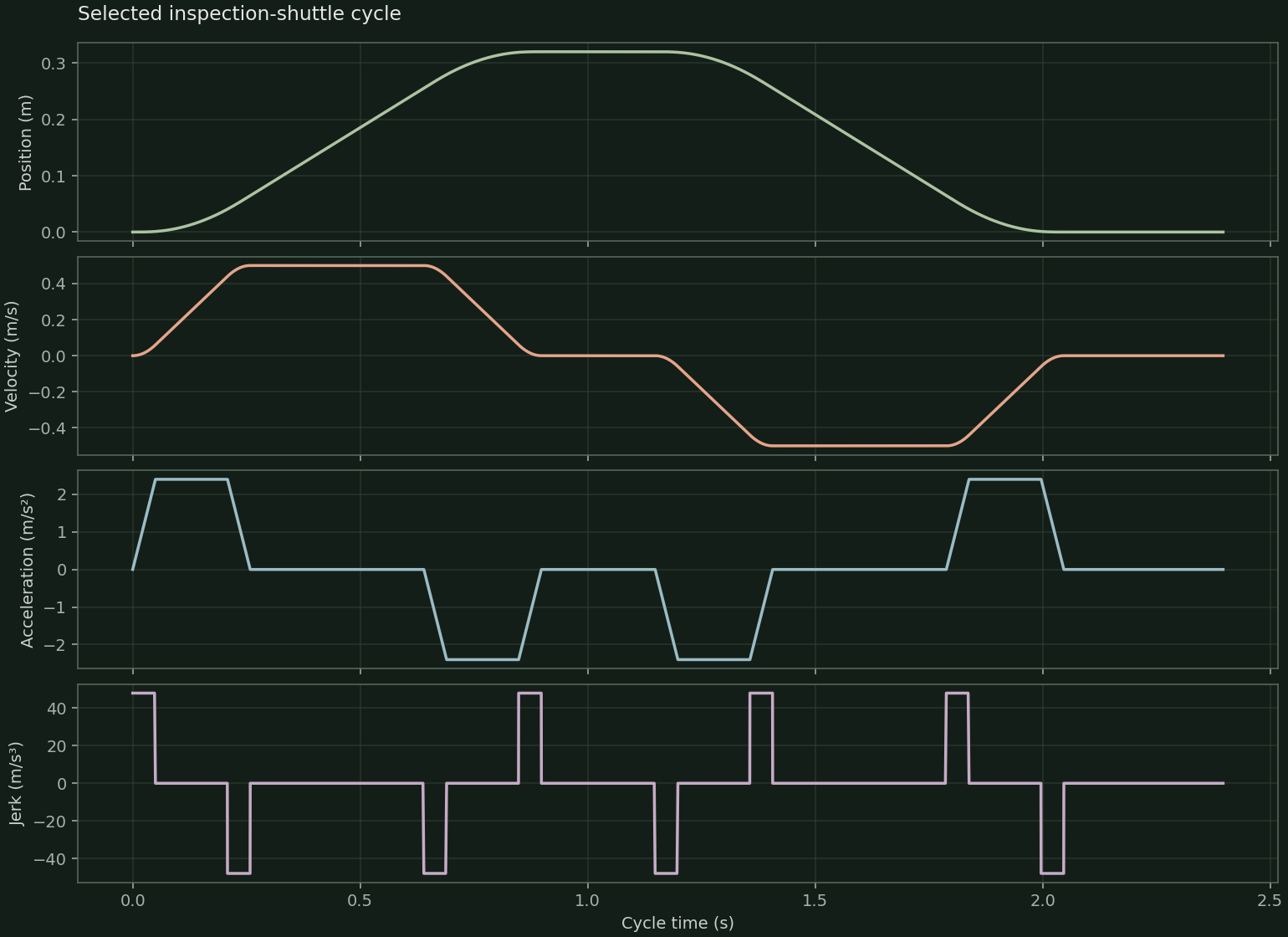
Exact piecewise integration of jerk into acceleration, velocity and position. Short moves omit phases without violating their limits.
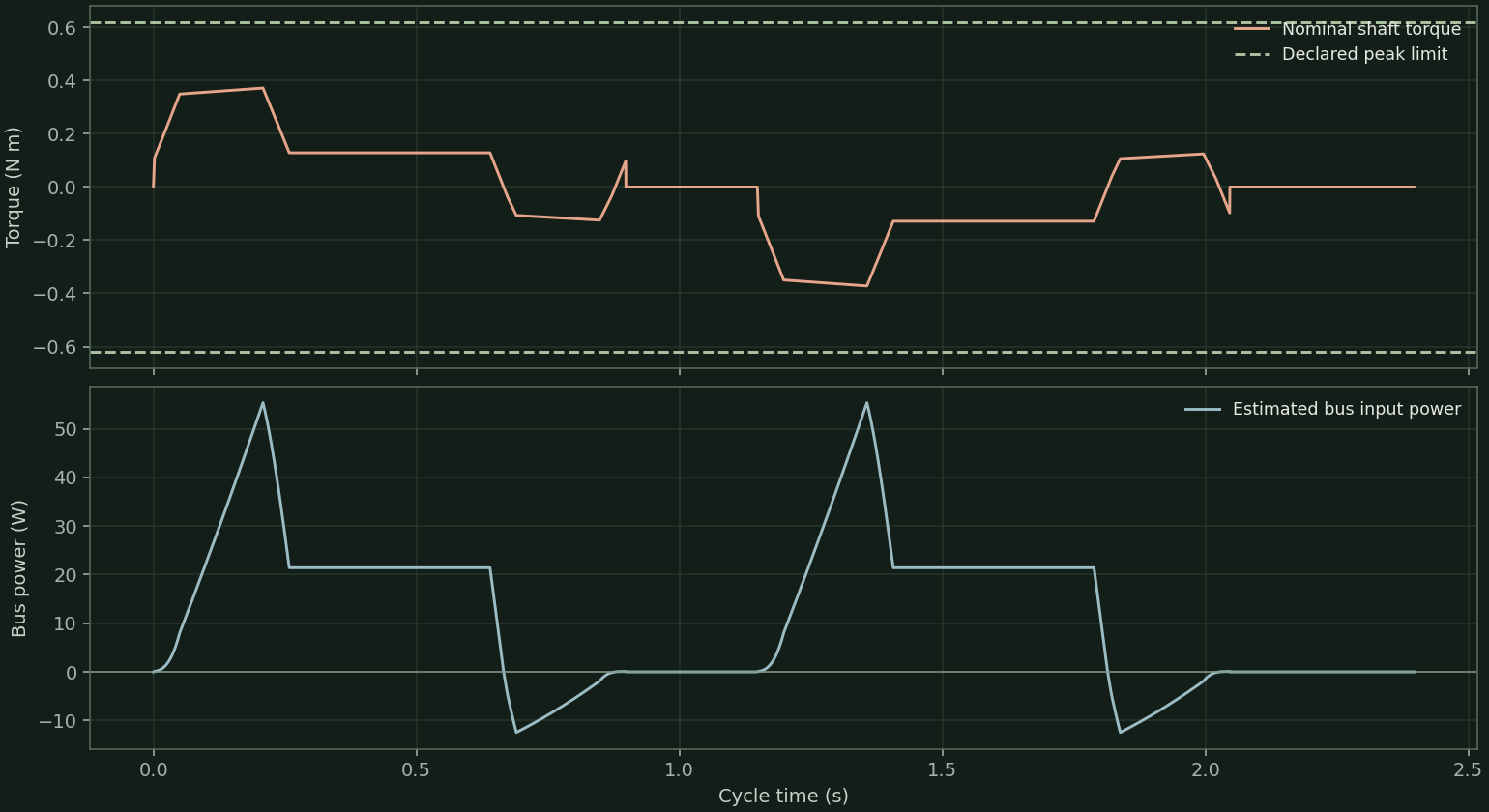
Polynomial torque extrema and duty integrals include translating mass, screw efficiency, rotating inertia, friction, copper losses and regenerative power.
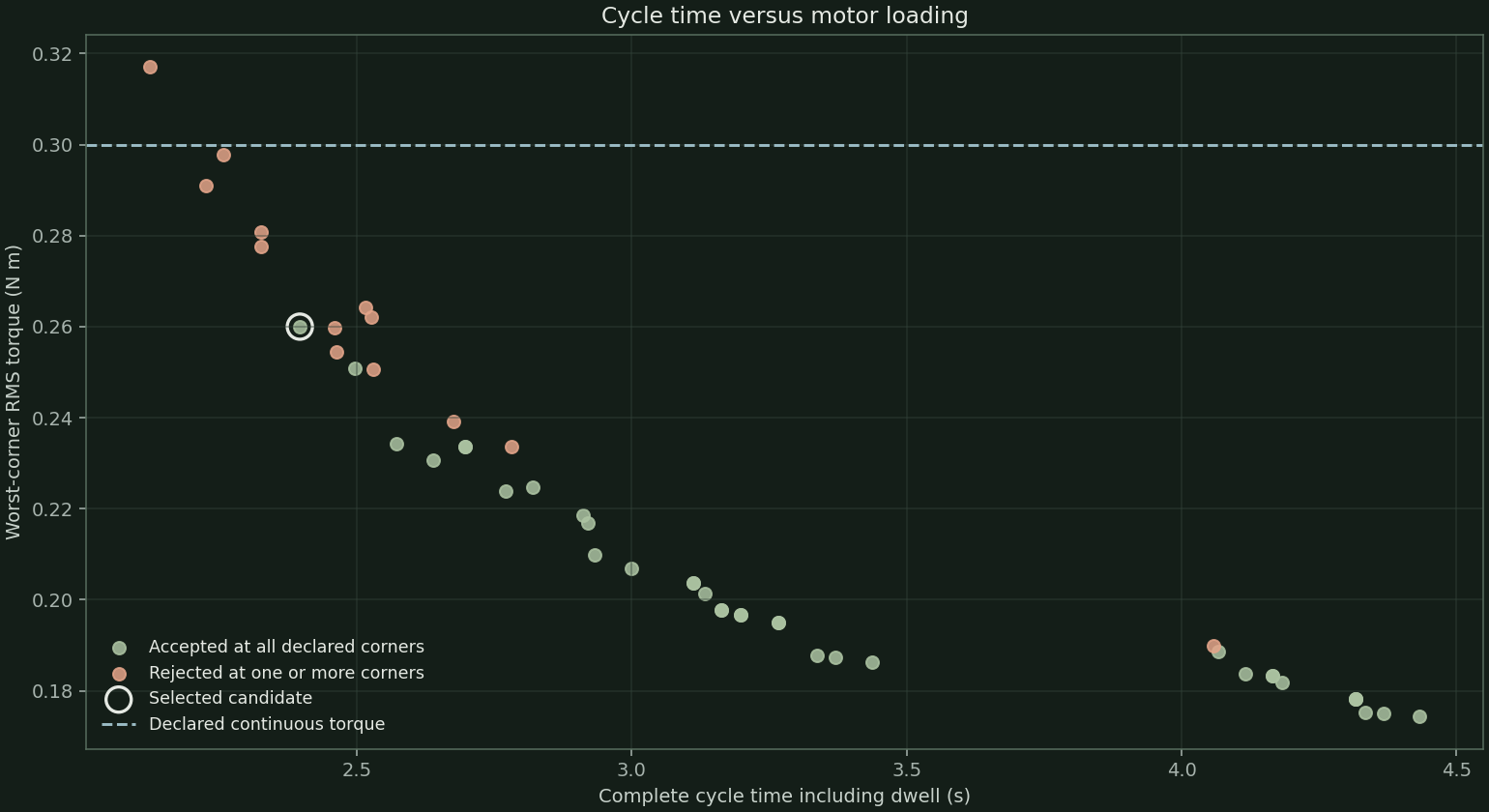
Forty-eight motion settings are compared at five declared load and efficiency corners. The output retains rejected limits and selects the shortest accepted grid cycle.
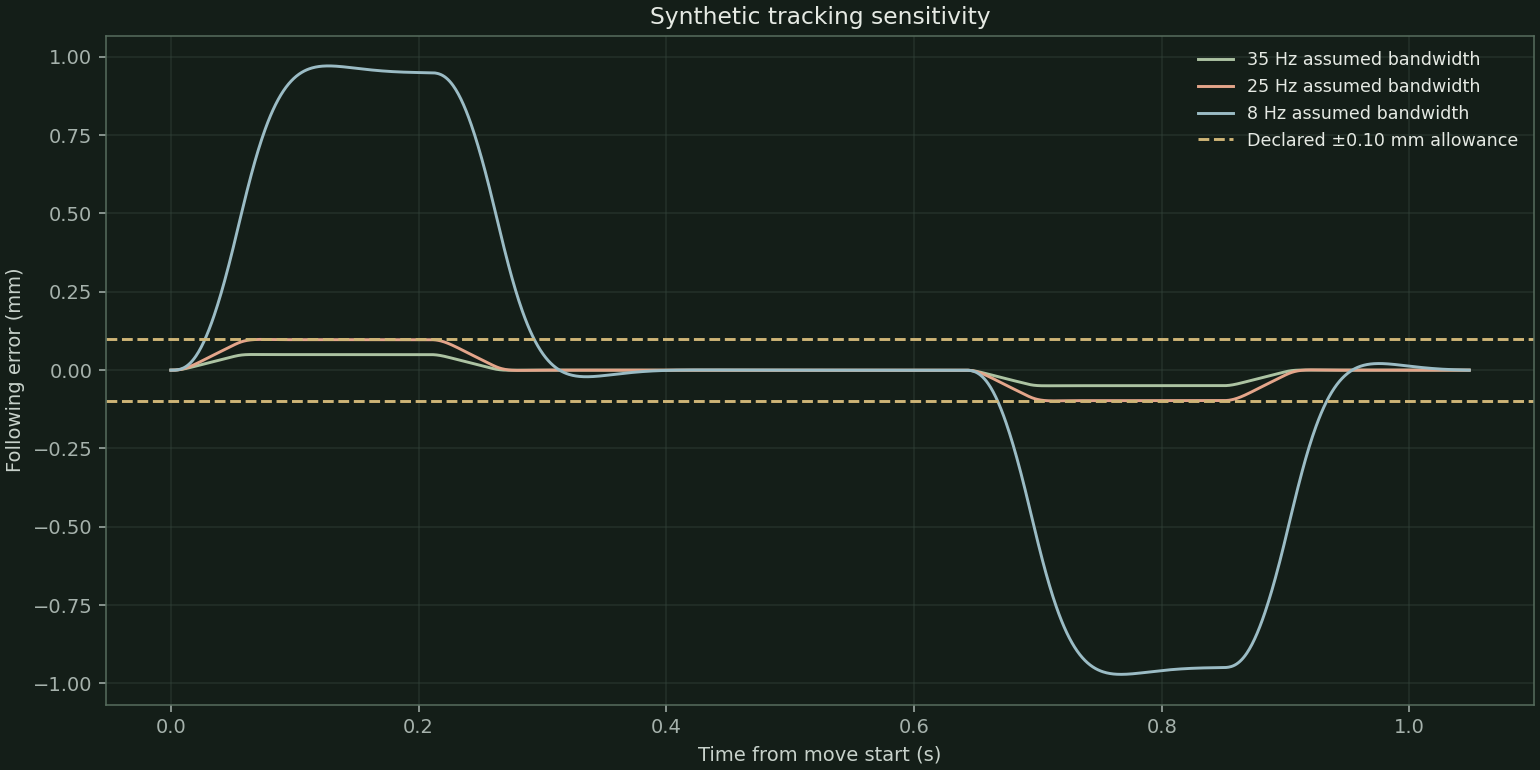
The commissioning counterpart executes second-order tracking, command quantization, overloaded-load rejection and integration refinement using declared synthetic inputs.
Inputs and assumptions
- Horizontal 320 mm inspection shuttle with 22 kg nominal moving mass, 20 mm screw lead, 0.25 s outward dwell and 0.35 s return dwell. All quantities are editable SI inputs.
- The selected drive envelope is a reference input: 0.30 N m continuous, 0.62 N m peak and 1,800 rpm. It does not identify a commercial motor.
- Five corners cover mass, friction, transmission efficiency and rotating inertia. The combined corner uses 30 kg moving mass.
- The tracking model assumes position/velocity command feedforward, a 0.75 damping ratio and declared 25, 35 or 8 Hz bandwidth. It is not fitted to measured hardware.
Results
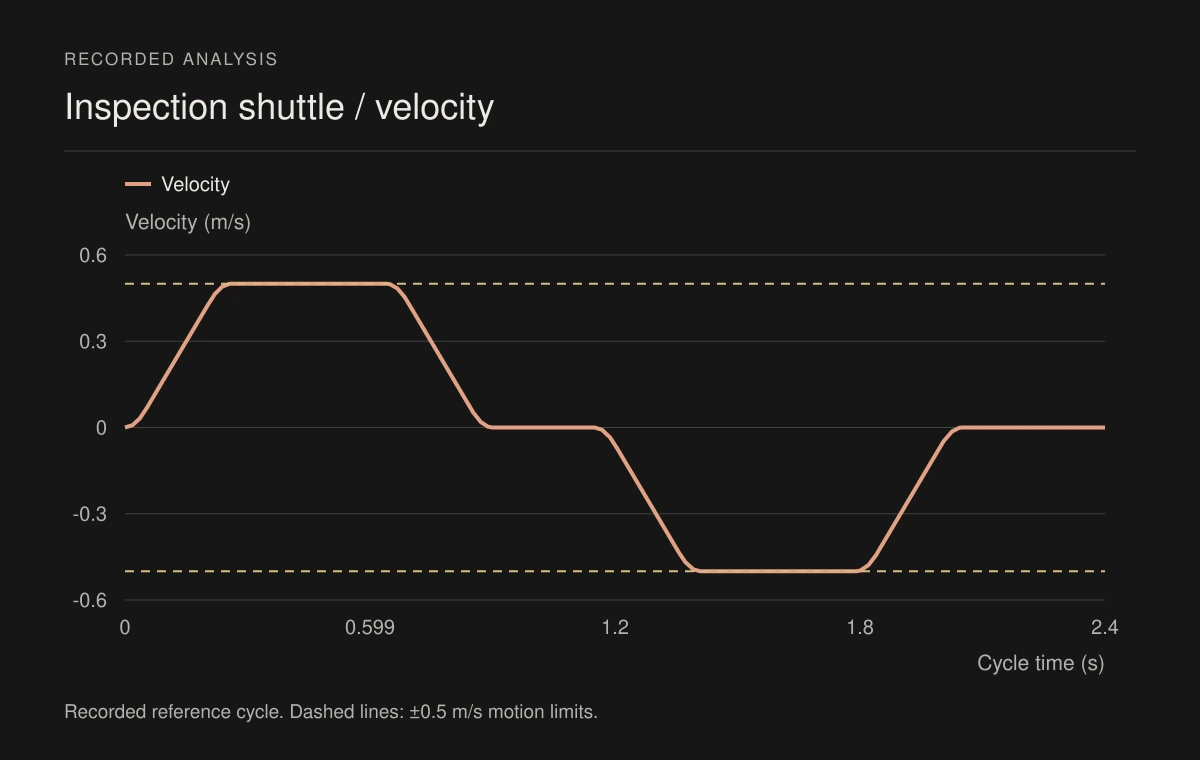
Inspection shuttle velocity
Compare the included analysis results.
| Candidate/corner calculations | 240 |
|---|---|
| Accepted motion settings | 35 of 48 |
| Selected complete cycle | 2.39667 s |
| Worst-corner RMS torque | 0.26 N m |
| Worst-corner peak torque | 0.55827 N m |
| 35 Hz synthetic following error | 0.04992 mm |
Report figures (4)
Verification
20 regression tests and 15 additional acceptance checks pass. The study evaluates 240 candidate/corner runs, exact energy balances, independent quadrature, a rejected overload and a rejected low-bandwidth tracking case.
python run.py && python verify.py && python complete_validation.pyAdditional scenarios
15 outcomes checked through executed numerical and synthetic commissioning study. The report lists the expected and observed outcomes for each check.
Read the validation report ↗Project files
The ZIP contains the source, inputs, results, and instructions. These files are also available individually.
- Trajectory and duty calculationsplanner.py · 11 KB
- Machine, motion grid and motor-envelope inputsinputs.json · 1 KB
- Selected motion and motor traceoutputs/selected-cycle.csv · 208 KB
- Exact phase coefficientsoutputs/selected-phase-table.csv · 1 KB
- All 240 load-corner calculationsoutputs/candidate-corners.csv · 88 KB
- Motion-setting comparisonoutputs/candidate-summary.csv · 4 KB
- Calculation report and derivationsreport.html · 12 KB
- Synthetic commissioning reportcompletion/report.html · 7 KB
- Declared tracking scenarioscompletion/tracking-summary.csv · 1 KB
- Regression teststest_planner.py · 6 KB
- Acceptance record and source hashescompletion.json · 7 KB
Archive checksum
SHA-256
5eeecccf22c25f8e56cf34e19dadc5b9ce35cc03f846eea71f89a042d8f07706Run locally
Python 3.12+ / NumPy 2.3.5 / SciPy 1.17.0 / Matplotlib 3.10.8
Extract the ZIP and open a terminal in the servo-axis-planner folder. The README includes setup and usage details.
python -m pip install -r requirements.txt
python run.py
python verify.py
python complete_validation.py
Limits
- The solver covers one horizontal axis with symmetric rest-to-rest moves. Vertical holding loads and arbitrary moving endpoint states are excluded.
- The motor envelope, efficiencies, friction and loop bandwidths are declared assumptions. No physical motor selection, drive tuning or measured accuracy is claimed.
- Regeneration includes the declared copper and conversion losses but does not model bus capacitance, voltage excursions or a selected resistor.
- Structural flexibility, backlash, screw critical speed, bearing life, winding temperature, safety limits and emergency stopping are outside this design study. The exported CSV is not machine-control firmware.