DC recorder backup
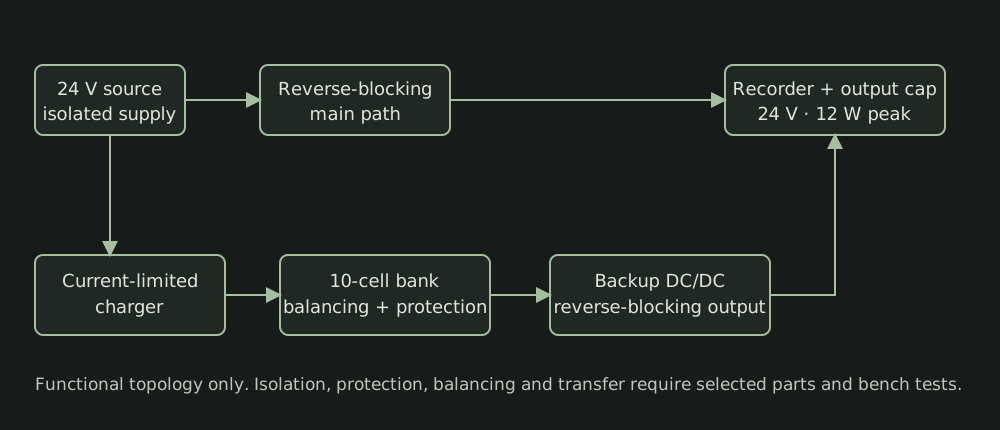
Executed energy and transfer study for a declared 24 V reference load. Hardware has not been built.
Result
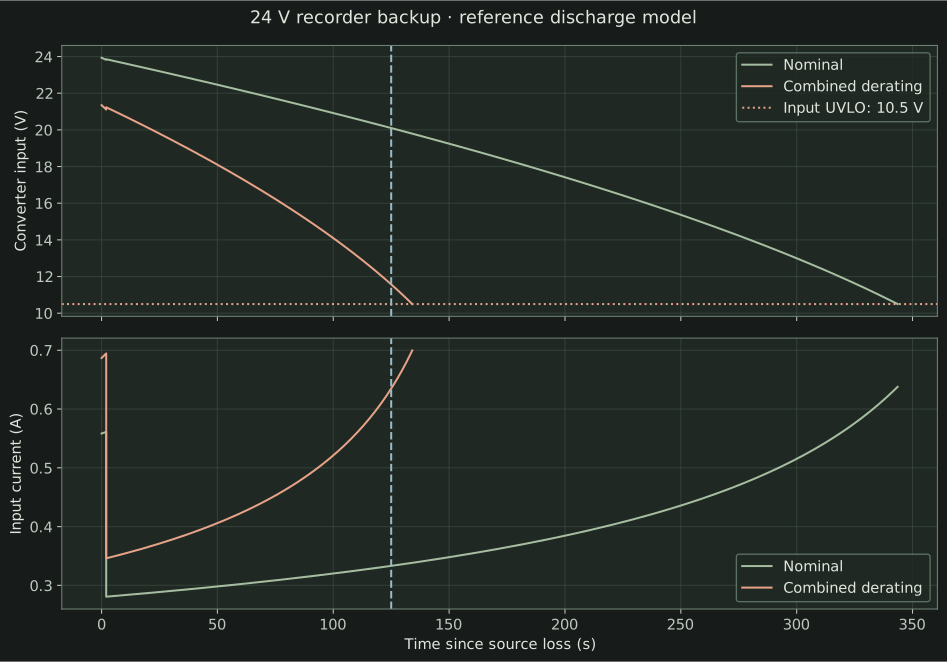
The combined-derating case supplies the load for 134.09 s, against a 125 s recording and shutdown target. The nominal model runs for 343.56 s.
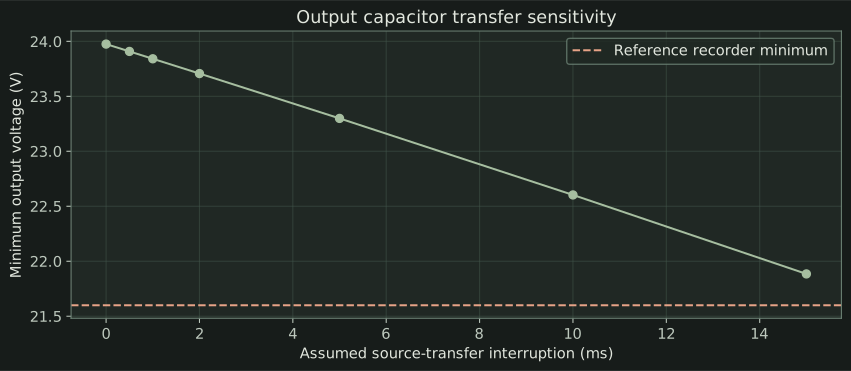
With a 2 ms interruption, the minimum modeled output is 23.707 V. The reference recorder minimum is 21.6 V.
Reference design
Load: 12 W for the first 2 s, then 6 W. Target: 120 s recording plus 5 s shutdown. The model keeps the 6 W load running after the target to measure margin.
Ten 100 F cells in series give 10 F nominal. Combined capacitance factors of 0.8 × 0.8 × 0.9 give 5.76 F. ESR rises from 0.12 to 0.36 ohm, charge starts at 21.6 V and efficiency falls to 82%. These are assumed design corners, not manufacturer ratings.
Calculation and checks
The model solves P = (Vcap − I × ESR) × I and dVcap/dt = −I/C. Load, converter and ESR energy are accumulated independently and checked against the decrease in ½CV². The two load intervals are integrated separately.
All 16 automated tests pass. They include the zero-ESR analytical solution, energy balance, integration refinement, current-limit cutoff, an undersized failing design and transfer-capacitor sensitivity.
| case | runtime_s | margin_to_125_s | meets_reference_target | ideal_upper_bound_s | load_energy_j | converter_loss_j | esr_loss_j | energy_residual_j | cutoff |
|---|---|---|---|---|---|---|---|---|---|
| Nominal | 343.55981 | 218.55981 | True | 345.7566 | 2073.35887 | 240.68 | 6.64585 | 4.547473508864641e-12 | input UVLO |
| Capacitance tolerance | 274.44851 | 149.44851 | True | 276.20707 | 1658.69107 | 192.53246 | 5.32423 | -2.0463630789890885e-12 | input UVLO |
| Aged capacitance | 219.15947 | 94.15947 | True | 220.56745 | 1326.95682 | 154.01443 | 4.26696 | 1.1596057447604835e-11 | input UVLO |
| Cold and aged ESR | 339.17105 | 214.17105 | True | 345.7566 | 2047.02631 | 237.6225 | 19.72961 | 7.275957614183426e-12 | input UVLO |
| 90% initial charge | 261.97281 | 136.97281 | True | 264.0443 | 1583.83687 | 183.84106 | 5.80679 | 3.865352482534945e-12 | input UVLO |
| Combined derating | 134.09225 | 9.09225 | True | 137.67913 | 816.55352 | 183.26622 | 10.93542 | -9.094947017729282e-13 | input UVLO |
| Undersized 20 F cells | 25.20505 | -99.79495 | False | 25.94236 | 163.23032 | 36.5872 | 2.33352 | 2.3860849296397646e-08 | input UVLO |
Transfer interruption
Storage comparison
| storage | deliverable_energy_to_cutoff_wh | required_load_wh | basis |
|---|---|---|---|
| 10 x 100 F series bank, nominal | 0.5759330182562789 | 0.21166666666666667 | Integrated ESR and converter model; 24 to 10.5 V input window |
| 10 x 100 F series bank, combined derating | 0.22682042316899592 | 0.21166666666666667 | 5.76 F, 0.36 ohm, 21.6 V initial, 82% conversion |
| Generic 19.2 V / 1 Ah battery reference | 7.31136 | 0.21166666666666667 | Energy estimate only; no discharge curve, peak current or BMS behavior modeled |
The battery row is an energy-only comparison. Its load current capability, discharge curve, protection, charging and life-cycle behavior have not been modeled. It is not a selected or approved battery pack.
Component criteria
| item | quantity | criterion | reason |
|---|---|---|---|
| Storage cells | 10 | 100 F nominal, 2.7 V rated each; qualify C >=57.6 F and ESR <=36 milliohm per cell at the declared combined corner | Series equivalent 5.76 F and 0.36 ohm; 24 V maximum bank charge; cell imbalance still requires monitoring |
| Cell balancing / voltage supervision | 1 | Monitor and balance all 10 cells; prevent any cell exceeding its qualified voltage/temperature envelope | Bank voltage alone cannot detect cell overvoltage; the virtual bench evaluates declared imbalance and ideal balancing cases |
| Current-limited charger | 1 | 24 V regulated bank endpoint; limit charge current and monitor temperature; isolate input on source loss | The virtual bench calculates ideal constant-current charging; real inrush and selected-part behavior remain model boundaries |
| Backup DC/DC stage | 1 | Regulated 24 V output, >=12 W peak, 10.5 to 24 V input, >=82% at worst corner, 2 A input capability | Efficiency and UVLO assumptions must be checked on selected parts across load and temperature |
| Power-path isolation | 2 | Reverse-blocking paths on main supply and backup output; voltage/current ratings after transient measurement | Model assumes ideal reverse isolation; no measured backfeed result |
| Output hold-up capacitor | 1 | 4700 microfarad nominal, >=3760 microfarad minimum, <=50 milliohm ESR; >=35 V voltage rating subject to transient qualification | Supports assumed 2 ms source transfer at 12 W |
| Protection and shutdown | 1 | Fuse/current limit sized against chosen conductors, short-circuit behavior and stored energy; recorder power-fail signal and verified shutdown acknowledgment | Electrical continuity cannot prove file-system integrity |
Limits and next hardware checks
- No physical circuit, PCB, purchased components or bench measurements are included. Values are reference qualification targets.
- The regulator is ideal apart from fixed efficiency, idle load, ESR, current limit and UVLO. The virtual bench adds reduced leakage, imbalance and charging models. Loop stability, actual thermal rise and selected-part dropout behavior remain outside the model.
- The 2 ms transfer interruption is an assumed requirement. Reverse blocking is a topology requirement, not a measured backfeed result.
- Recorder file integrity and shutdown completion need tests on the actual device. A passing energy calculation does not establish either.
bench_acceptance.md records the unexecuted bench checks. Read results/summary.json, test-log.txt and verification.json for the executed evidence.
Source and reproduction
Method reference: Analog Devices, Energy Storage Using Supercapacitors. It informs loss and degradation treatment; numerical inputs here are separately declared assumptions.
python -m pip install -r requirements.txt
python run.py
python -m unittest -v
Virtual validation
Executed synthetic and theoretical run-through. The report includes cases, acceptance results and model boundaries.