SYNTHETIC / THEORETICAL VALIDATION
Mounting fixture commissioning study
The calculations and generated trials below were executed using the supplied source and declared inputs. They are not measurements from manufactured hardware.
Selected operating envelope
The revised reference fixture uses flanged hardened-steel bushes with 30 x 14 x 3 mm steel caps, two M3 x 10 screws per cap, and the supplied toe clamps. The calculated envelope is 40 N lateral force plus 0.6 N m drill torque, 150 N pullup, 350 N downward thrust, 2.8-3.2 N m M6 toe-clamp torque, friction at least 0.12, and fixture temperature 10-35 C. The 0.20 mm radial allowance applies to the stated unworn locating inputs. Caps use 0.22-0.28 N m seating torque and 5 mm thread engagement. Every selected-load acceptance check passes; the original bare fit and worn/loose cases are retained as rejected alternatives.
| design_pullup_N | cap_bending_MPa | cap_allowable_MPa | screw_load_N | preload_max_N | screw_proof_capacity_N | thread_shear_capacity_N | flange_bearing_MPa | flange_allowable_MPa |
|---|---|---|---|---|---|---|---|---|
| 300 | 110.52631578947368 | 166.66666666666666 | 150.0 | 518.5185185185185 | 2917.4 | 981.7477042468104 | 3.9788735772973833 | 60 |
Decision
The locating stack fits the 0.20 mm radial allowance in its unworn condition. The assumed 2.8-3.2 N m clamp torque range meets the stated side-load, pullup and elastic toe screens. Worn guides and loose/oily clamps are rejected. The bare press-fit alternative failed the axial-retention screen. The supplied CAD now includes flanged bushes and two-screw caps, with a checked retention load path independent of the interference fit.
Declared load and material envelope
| parameter | value |
|---|---|
| seed | 42017 |
| operators | 3 |
| cycles_per_operator | 10 |
| screw_diameter_mm | 6 |
| torque_Nm | [2.8, 3.0, 3.2] |
| nut_factor | [0.18, 0.25] |
| heel_y_mm | 54 |
| screw_y_mm | 50 |
| toe_y_mm | 39 |
| toe_width_mm | 20 |
| toe_thickness_mm | 4 |
| clamp_yield_MPa | 250 |
| minimum_clamp_friction | 0.12 |
| normal_drill_torque_Nm | 0.6 |
| normal_lateral_force_N | 40 |
| maximum_pullup_N | 150 |
| maximum_downthrust_N | 350 |
| friction_lever_arm_mm | 50 |
| design_factor | 2 |
| stress_factor | 1.5 |
| worn_bushing_additional_radial_mm | 0.025 |
| steel_E_MPa | 200000 |
| steel_poisson | 0.3 |
| aluminum_E_MPa | 69000 |
| aluminum_poisson | 0.33 |
| steel_expansion_per_K | 1.2e-05 |
| aluminum_expansion_per_K | 2.3e-05 |
| bushing_engagement_mm | 8 |
| equivalent_host_outer_radius_mm | 10 |
| bushing_interface_friction | 0.1 |
| bushing_interference_mm | [0.002, 0.018] |
| temperature_C | [10, 20, 35, 60] |
| retainer | {'span_mm': 21, 'width_mm': 14, 'thickness_mm': 3, 'flange_diameter_mm': 14, 'stem_diameter_mm': 10, 'screw_tensile_area_mm2': 5.03, 'screw_proof_MPa': 580, 'thread_pitch_diameter_mm': 2.5, 'thread_engagement_mm': 5, 'aluminum_thread_shear_allowable_MPa': 50, 'flange_bearing_allowable_MPa': 60, 'seating_torque_Nm': [0.22, 0.28], 'nut_factor': [0.18, 0.25], 'drill_clearance_diameter_mm': 4.5} |
Clamp and support calculation
Screw preload F = T/(K d). Toe force follows lever equilibrium about the heel: Ftoe = F (54-50)/(54-39). Both toe forces resist upward pull; conservative lateral demand is side force plus drilling torque divided by a 50 mm friction arm. Toe stress is M/Z with Z = b h squared / 6. The three pad reactions solve force and two moment equations for every drilled point.
| torque_Nm | nut_factor | preload_N | toe_force_each_N | clamp_bending_MPa | friction_capacity_N | normal_force_margin | pullup_margin |
|---|---|---|---|---|---|---|---|
| 2.8 | 0.18 | 2592.5925925925926 | 691.3580246913581 | 142.59259259259258 | 165.92592592592592 | 1.5954415954415955 | 4.609053497942387 |
| 2.8 | 0.25 | 1866.6666666666667 | 497.77777777777777 | 102.66666666666666 | 119.46666666666665 | 1.1487179487179486 | 3.3185185185185184 |
| 3.0 | 0.18 | 2777.7777777777774 | 740.7407407407406 | 152.77777777777774 | 177.77777777777774 | 1.709401709401709 | 4.938271604938271 |
| 3.0 | 0.25 | 2000.0 | 533.3333333333334 | 110.0 | 128.0 | 1.2307692307692308 | 3.555555555555556 |
| 3.2 | 0.18 | 2962.9629629629626 | 790.1234567901233 | 162.96296296296293 | 189.6296296296296 | 1.823361823361823 | 5.2674897119341555 |
| 3.2 | 0.25 | 2133.3333333333335 | 568.8888888888889 | 117.33333333333334 | 136.53333333333333 | 1.3128205128205128 | 3.7925925925925927 |
| variant | hole | x_mm | y_mm | pad_1_N | pad_2_N | pad_3_N | minimum_reaction_N | maximum_pad_pressure_MPa | force_residual_N |
|---|---|---|---|---|---|---|---|---|---|
| A | 1 | -25 | -20 | 503.36363636363643 | 308.919191919192 | 533.2727272727274 | 308.919191919192 | 4.715166142308375 | 1.1368683772161603e-13 |
| A | 2 | 25 | -20 | 308.9191919191919 | 503.3636363636364 | 533.2727272727273 | 308.9191919191919 | 4.715166142308374 | 1.1368683772161603e-13 |
| A | 3 | 0 | 20 | 278.8686868686869 | 278.8686868686869 | 787.8181818181819 | 278.8686868686869 | 6.965842105224066 | 1.1368683772161603e-13 |
| B | 1 | -28 | -18 | 508.6666666666666 | 290.8888888888888 | 545.9999999999999 | 290.8888888888888 | 4.827699940454158 | 3.410605131648481e-13 |
| B | 2 | 28 | -18 | 290.8888888888889 | 508.6666666666667 | 546.0 | 290.8888888888889 | 4.827699940454159 | 1.1368683772161603e-13 |
| B | 3 | 0 | 24 | 266.14141414141415 | 266.14141414141415 | 813.2727272727273 | 266.14141414141415 | 7.1909097015156345 | 1.1368683772161603e-13 |
| C | 1 | -30 | -22 | 529.1717171717172 | 295.83838383838383 | 520.5454545454545 | 295.83838383838383 | 4.678905251794733 | 1.1368683772161603e-13 |
| C | 2 | 30 | -22 | 295.8383838383839 | 529.1717171717172 | 520.5454545454545 | 295.8383838383839 | 4.678905251794733 | 1.1368683772161603e-13 |
| C | 3 | 0 | 22 | 272.50505050505046 | 272.50505050505046 | 800.5454545454545 | 272.50505050505046 | 7.07837590336985 | 1.1368683772161603e-13 |
Synthetic multi-operator trial
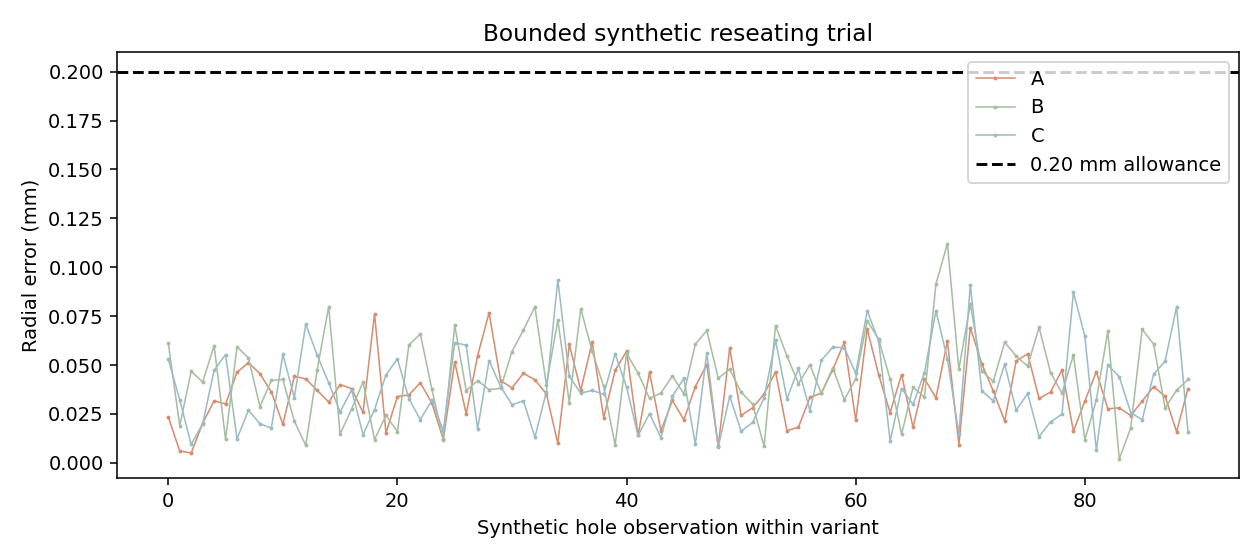
Seed 42017 generates fixed locator/bushing errors per variant and bounded reseating, angular, guide-clearance and drill-walk errors. Radial terms are uniformly sampled in disks; rotation is uniform within its bound. These are assumed input distributions. Fixed errors remain fixed over the trial. The deterministic worst-case stack governs acceptance.
| variant | normal_worst_radial_mm | worn_worst_radial_mm | target_mm | remaining_wear_radial_mm | normal_accepted | worn_accepted |
|---|---|---|---|---|---|---|
| A | 0.18275597394173826 | 0.20775597394173825 | 0.2 | 0.017244026058261752 | True | False |
| B | 0.1846528925339747 | 0.2096528925339747 | 0.2 | 0.0153471074660253 | True | False |
| C | 0.187117793065494 | 0.212117793065494 | 0.2 | 0.012882206934506008 | True | False |
Bushing retention and thermal fit
Effective diametral interference equals cold interference minus D (alpha aluminum minus alpha steel) (T-20). Elastic thick-cylinder radial compliances of the insert annulus and hollow steel bush are added. Pressure is nonnegative; axial friction resistance is mu p pi D L. No shoulder or adhesive is assumed. The worst minimum fit loses contact at 60 C; at 20 C it also fails the factor-two pullup requirement.
| temperature_C | initial_interference_mm | effective_interference_mm | contact_pressure_MPa | axial_retention_N | retention_target_N | meets_retention_target |
|---|---|---|---|---|---|---|
| 10 | 0.002 | 0.0031 | 8.964974989356612 | 225.31439652943178 | 300 | False |
| 20 | 0.002 | 0.002 | 5.783854831842976 | 145.36412679318178 | 300 | False |
| 35 | 0.002 | 0.00035000000000000027 | 1.0121745955725214 | 25.43872218880683 | 300 | False |
| 60 | 0.002 | -0.0023999999999999994 | 0.0 | 0.0 | 300 | False |
| 10 | 0.018 | 0.0191 | 55.23581364410041 | 1388.227410874886 | 300 | True |
| 20 | 0.018 | 0.018 | 52.05469348658678 | 1308.2771411386357 | 300 | True |
| 35 | 0.018 | 0.01635 | 47.28301325031632 | 1188.351736534261 | 300 | True |
| 60 | 0.018 | 0.0136 | 39.330212856532235 | 988.4760621936362 | 300 | True |
Files
CSV files include every synthetic hole observation, clamp corner case, pad reaction, wear budget and press-fit condition. Expected rejected cases remain in the acceptance matrix so a passing script cannot hide an unsuitable design condition.
Executed acceptance matrix
| id | description | expected | observed | passed |
|---|---|---|---|---|
| clamp-normal | Declared normal drilling side load with factor 2 | minimum capacity/demand >= 1 | 1.14872 | True |
| clamp-stress | 4 mm steel toe bending with factor 1.5 | <= 166.6667 MPa | 162.96296 | True |
| clamp-pullup | Both clamps resist declared pullup with factor 2 | margin >= 1 | 3.3185 | True |
| pad-contact | Three supports remain compressed at every drilling point | all pad reactions > 0 N | 266.1414 | True |
| pad-equilibrium | Reaction forces balance toe load and thrust | residual < 1e-9 N | 3.410605131648481e-13 | True |
| reseating-count | Three operators, ten reseats, three variants, three holes | 270 recorded hole locations | 270 | True |
| reseating-envelope | Synthetic hole errors stay within the conservative envelope | max <= 0.20 mm | 0.11210907822177502 | True |
| wear-rejection | An extra 0.025 mm radial bushing clearance exceeds allowance | reject every variant | [False, False, False] | True |
| hot-fit-rejection | Minimum press fit is lost at 60 C | effective interference < 0; zero retention | -0.0023999999999999994 | True |
| retention-screen | Bare minimum-interference press fit does not satisfy pullup factor 2 | reject minimum-fit retention at 20 C | 145.364 | True |
| loose-clamp-rejection | Loose oily clamps cannot meet side-force criterion | margin < 1 | 0.11965811965811966 | True |
| retainer-cap | Selected retention cap carries factor-two pullup | bending <= yield/1.5 | 110.52631578947368 | True |
| retainer-fasteners | Two M3 screws and tapped insert carry pullup plus maximum seating preload | load+preload below screw proof and thread screen | {'combined_N': 668.5185185185185, 'proof_N': 2917.4, 'thread_N': 981.7477042468104} | True |
| retainer-flange | Flange bearing is adequate under factor-two pullup/downward screen | pressure <= 60 MPa | 3.9788735772973833 | True |
Model boundaries
- The loads, friction coefficients, nut factors, elastic properties and process errors are declared scenarios. No measured drill forces, torque calibration or process capability is implied.
- Clamp screening treats the toe as a rectangular elastic beam. Local fillets, screw-hole stress, threads, plate bending and impact require a more detailed model before hardware release.
- The press-fit host is approximated as a concentric annulus of 10 mm outer radius. Nearby insert edges and holes make the real stiffness non-axisymmetric. This is a retention screening calculation, not a certified press-fit load.
- The original bare press-fit alternative fails the retention screen and is rejected. The supplied revised CAD uses flanged bushes and two-screw retention caps; numerical retention checks do not establish physical assembly durability.
- Synthetic operators share a bounded error model. The sample does not establish Cpk, operator performance or a real repeatability distribution.
Reproduce
From this project folder, run python complete_validation.py. Run python test_completion.py for independent regression checks. Inputs are in completion-inputs.json; machine-readable outcomes and source hashes are in completion.json.