Thermal tooling · Thermal analysis
Heated platen
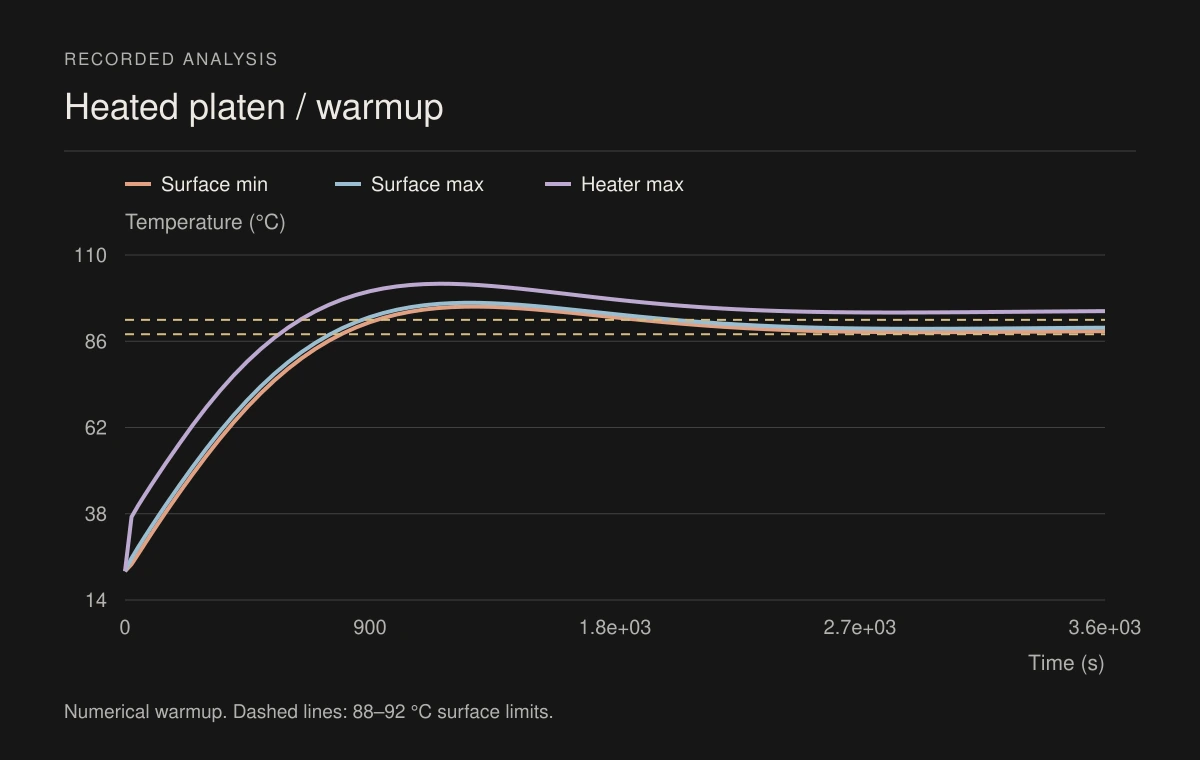
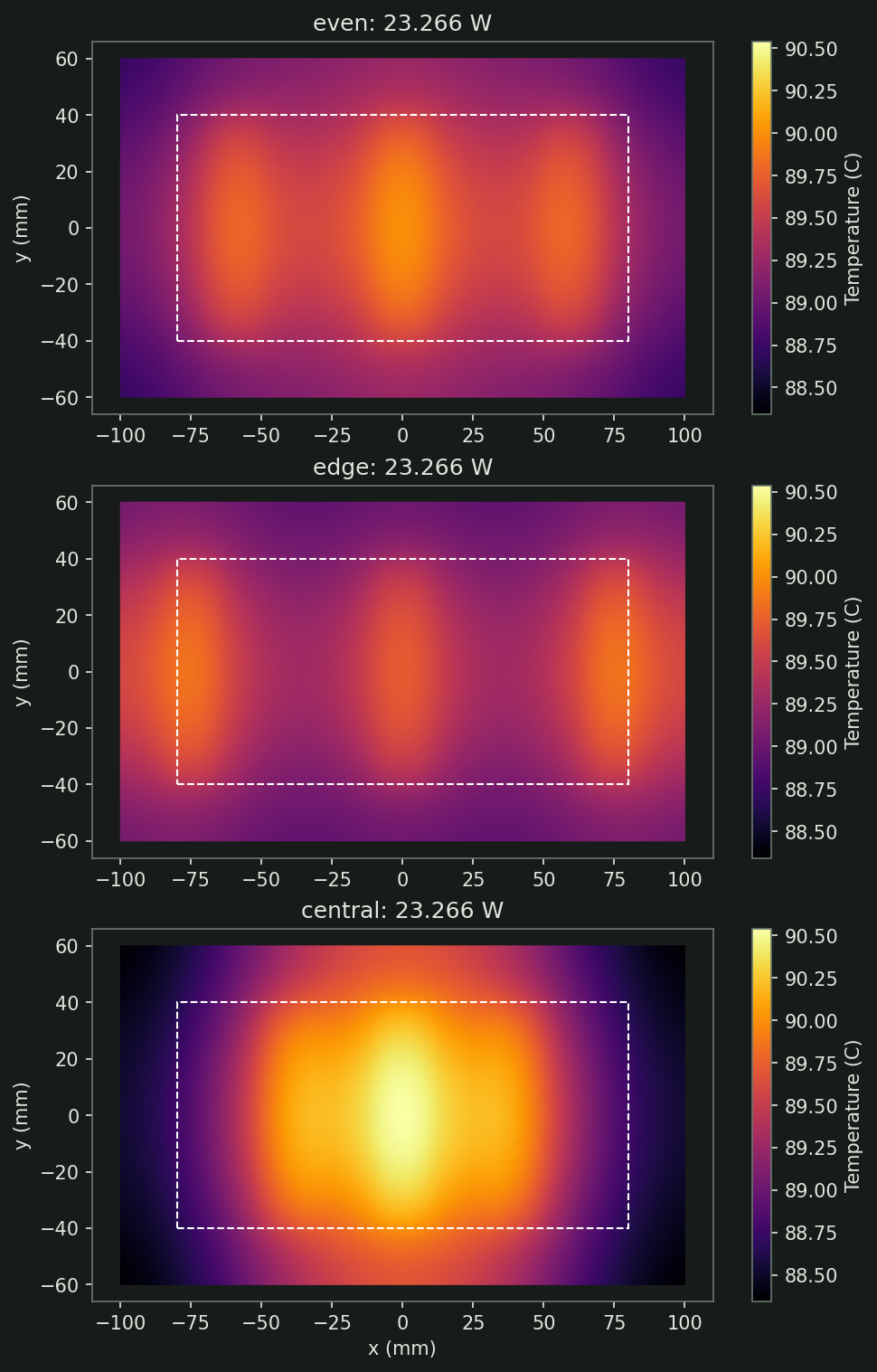
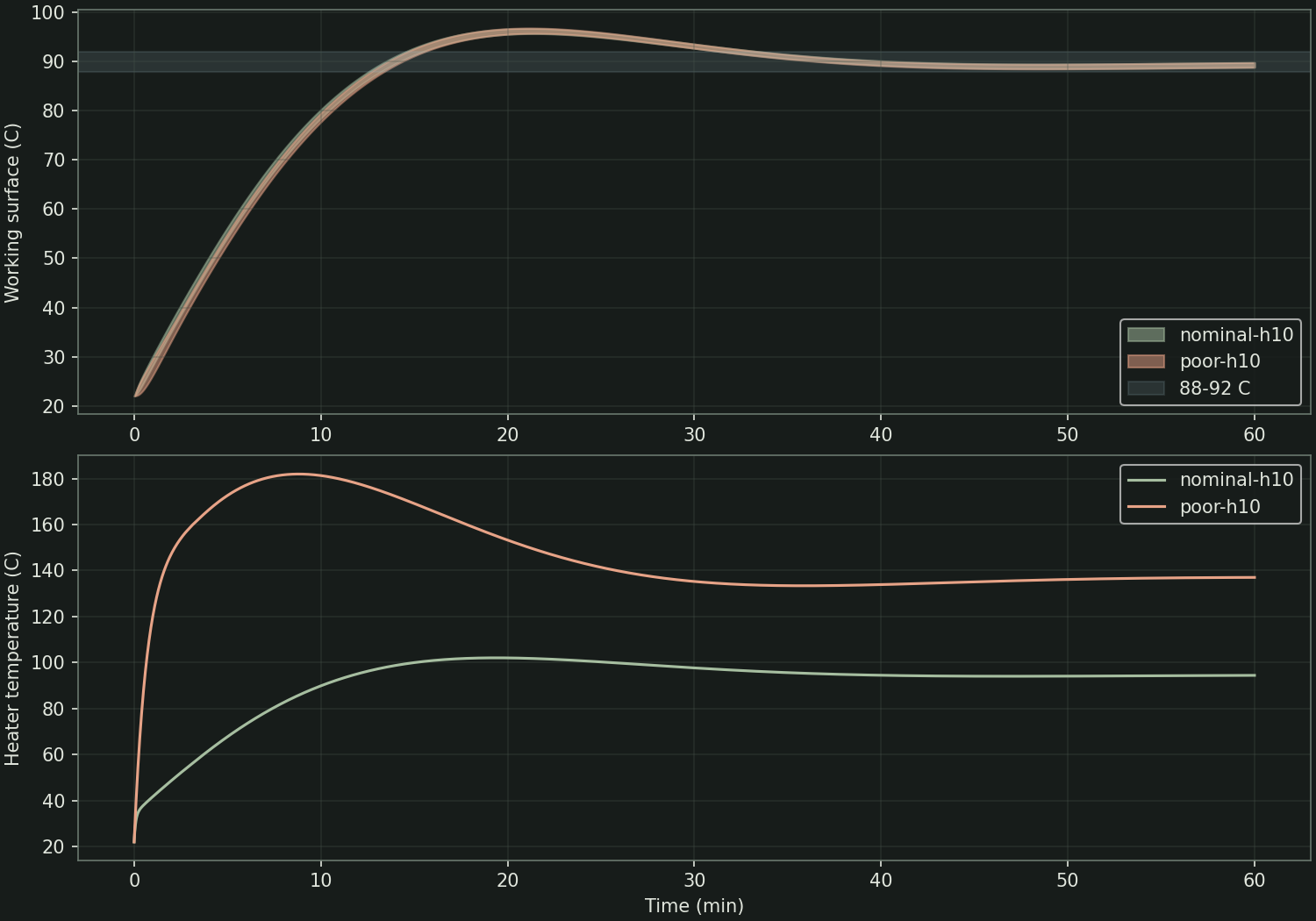
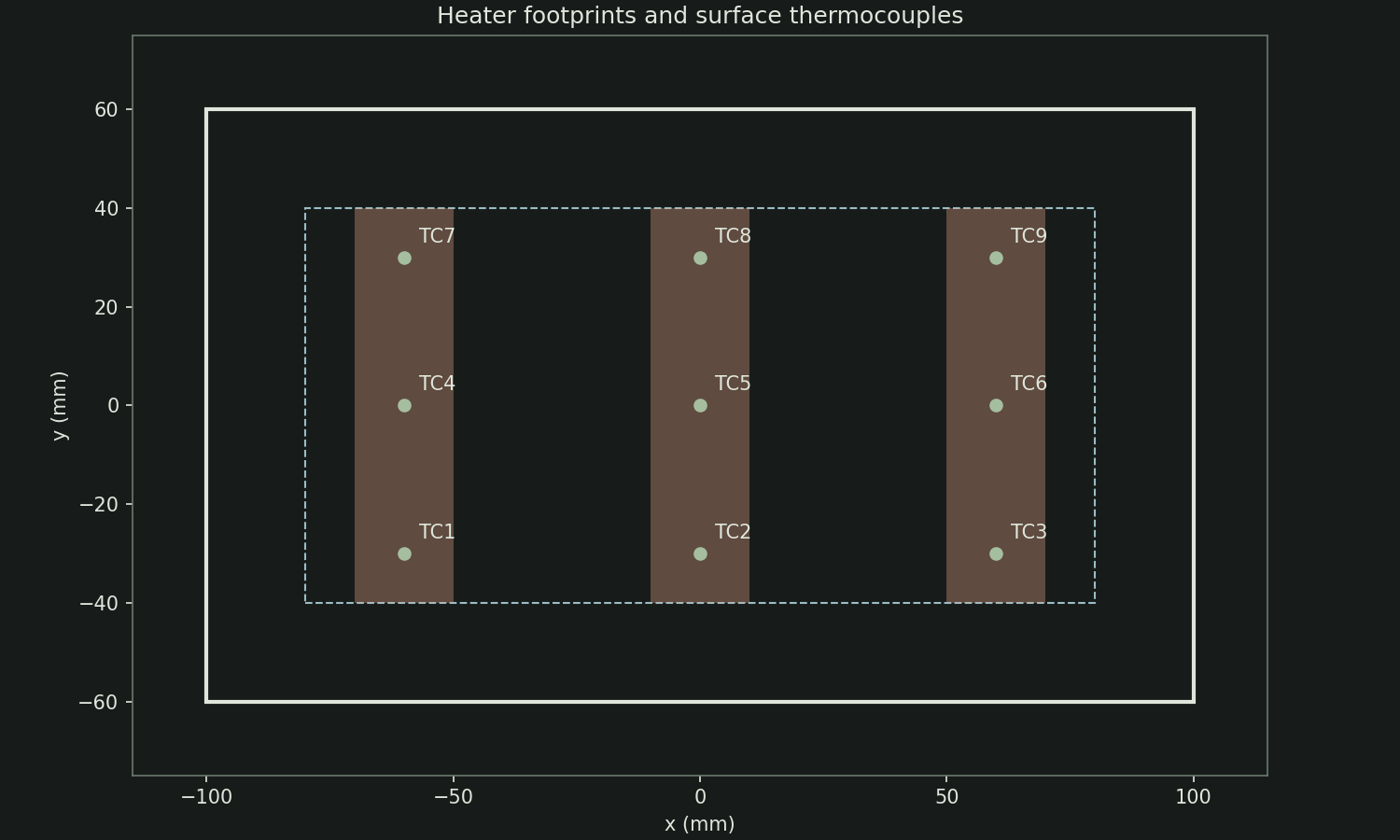
Three heater layouts for an aluminum platen, compared at equal power. The study checks surface temperature variation, contact resistance, and warm-up behavior.
Thermal analysis with completed fault study
Implementation
Linear triangular plate elements coupled to three heater thermal masses.
Eighteen fixed-power cases and six controlled warm-up cases.
Executed spatial/time refinement, analytical limiting case and energy balances.
Executed 15 thermal and fault scenarios including open heater, poor contact, stuck output, frozen/open/biased sensor, ambient and insulation changes.
The selected numerical protection latches an independent power cutoff; the process readiness gate uses the full working surface for a 300 s hold.
Inputs and assumptions
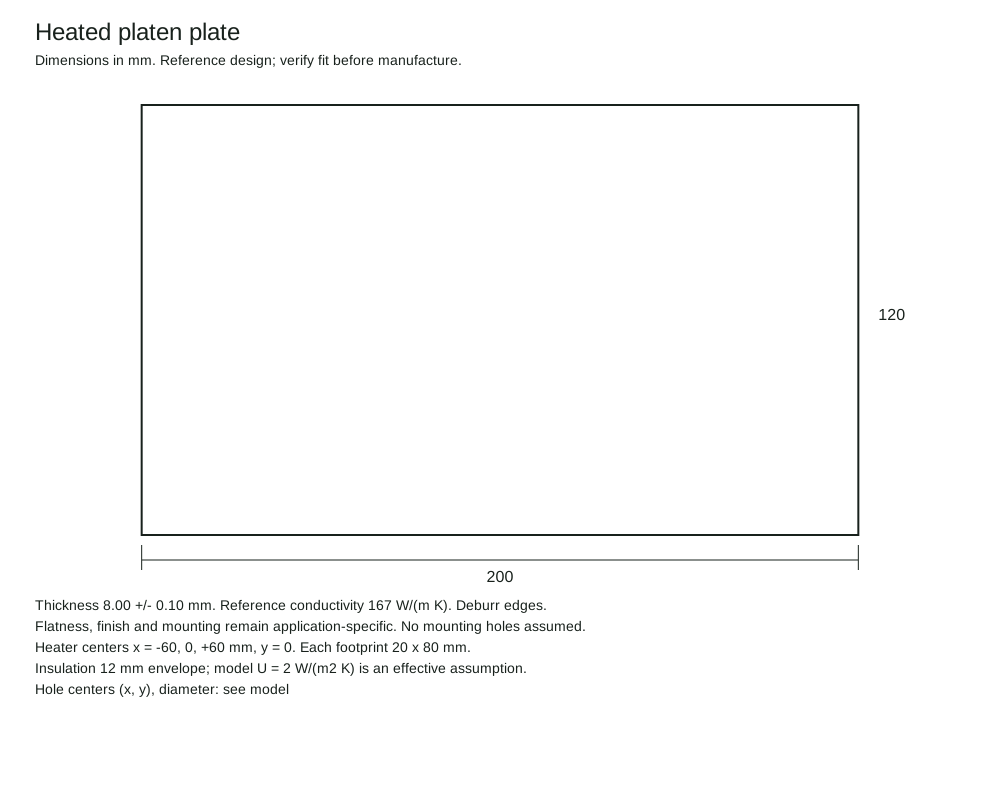
- 200 x 120 x 8 mm reference aluminum plate and central 160 x 80 mm working area.
- Heat-transfer and contact coefficients are sensitivity inputs, not measured values.
Results
| Steady cases | 18 |
|---|---|
| Nominal surface range | 0.957 C |
| Nominal settled time | 2018 s |
| Thermal and fault scenarios | 15 |
| Accepted ambient/loss cases | 6 |
| Normal full-surface readiness | 2318 s |
Report figures (2)
Verification
29 numerical checks pass; regression tests are included. 27 commissioning acceptance checks and 5 additional regressions pass. Six selected ambient/loss cases finish in band; all modeled fault cases retain energy balance and expected rejected/protected outcomes.
python run.py && python test_project.py && python complete_validation.py && python test_completion.pyAdditional scenarios
27 outcomes checked through synthetic/theoretical. The report lists the expected and observed outcomes for each check.
Read the validation report ↗Project files
The ZIP contains the source, inputs, results, and instructions. These files are also available individually.
- Thermal solversolver.py · 6 KB
- Geometry and thermal inputsinputs.json · 1 KB
- Steady resultsoutputs/steady-cases.csv · 3 KB
- Warm-up resultsoutputs/controlled-cases.csv · 1 KB
- Nominal assembly STEPoutputs/cad/thermal-stack.step · 79 KB
- Plate drawingoutputs/platen-drawing.svg · 1 KB
- Sensor layoutoutputs/sensor-layout.png · 44 KB
- Thermal reportreport.html · 8 KB
- Executed thermal and fault outcomescompletion/fault-summary.csv · 3 KB
- Protected stuck-output tracecompletion/relay_stuck_protected.csv · 315 KB
- Cutoff timestep refinementcompletion/cutoff-refinement.json · 1 KB
- Executed commissioning and fault studycompletion/report.html · 14 KB
- Completion acceptance matrix and source hashescompletion.json · 11 KB
- Reproduce the commissioning studycomplete_validation.py · 13 KB
- Declared commissioning inputscompletion-inputs.json · 2 KB
Archive checksum
SHA-256
0c6fc65ebb67a200e66ff00786a4b4e710afee5f9095fb716a63c17e6ac1b874Original project scope
Archived brief PDF ↗Run locally
Python 3.12 / scikit-fem / SciPy / NumPy / Matplotlib / CadQuery
Extract the ZIP and open a terminal in the heated-platen folder. The README includes setup and usage details.
python -m pip install -r requirements.txt
python run.py
python test_project.py
python complete_validation.py
python test_completion.py
Limits
- A 2D thin-plate model assumes uniform through-thickness temperature; effective surface losses and contact conductance are declared inputs.
- Independent cutoff sensing, contactor action and 2 s response are modeled assumptions. The executed fault study does not certify actual protective hardware or firmware.
- The selected envelope requires three functioning heaters and nominal contact. Poor contact, an open heater, biased sensor and high insulation losses are explicitly rejected operating states.
- No physical heating, sensor calibration, electrical qualification, fire assessment or adhesive-curing performance is claimed.